Why a Repeated Shape Can Make an Outfit Feel Settled
A repeated shape can make an outfit feel settled without matching colours. Learn where to echo a curve, angle or line and how to choose the right pair.
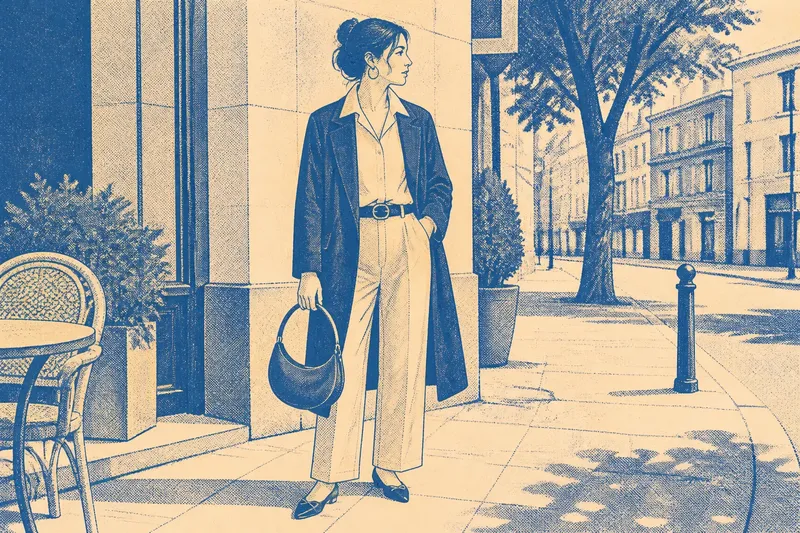
A repeated shape can make an outfit feel settled even when its colours do not match. A rounded neckline echoed by a curved bag handle, or a sharp collar picked up in angular shoes, gives the eye a small connection to follow without making the clothes look like a set.
The useful word is echo, not duplicate. Repeating one visual shape in two separate pieces creates a quiet relationship; repeating every detail can make the outfit feel prescribed. The best pairing depends on how noticeable you want that relationship to be, and on which shapes already have a reason to be in the outfit.
What counts as a repeated shape?
Shape here means the outline or direction a detail makes, rather than its colour or pattern. A round neckline, a pointed collar, a boxy pocket, a long vertical seam and a curved shoe toe can all create readable forms. The shape may be part of a garment or supplied by an accessory.
Look at the outfit from a little distance, or use a mirror that shows it from head to toe. Rather than catalogue every detail, notice what catches your eye first: perhaps a wide lapel, a circular earring or the straight fall of a long jacket. Echoing that feature elsewhere gives the eye a second place to land.
The repeated forms need not be identical. A rounded bag handle can answer a curved neckline without copying its exact arc. A pointed collar may find a looser counterpart in the tapered toe of a flat. Similar direction or character is usually enough.
Should the echo be subtle, clear or prominent?
There are three useful approaches: a small echo, a clear pairing or a prominent motif. None is inherently more polished. Choose by the role you want the repeated shape to play and by how much visual activity the rest of the outfit already contains.
When does a subtle echo work best?
A subtle echo suits an outfit whose main interest is already elsewhere, or a wearer who prefers connection that is noticed gradually. It might be a softly curved bag handle alongside the curve of a collar, or a narrow vertical stripe in a top answering the long opening of a cardigan. The shapes agree without becoming the headline.
For this approach, choose details with a similar direction but different scale or material. A small curved buckle can nod to a rounded neckline without insisting on a precise match. If the echo only becomes visible on close inspection, that is not a failure; subtle means the relationship can sit quietly.
When should the pairing be easy to see?
A clear pairing suits an outfit that needs an organising thread, especially if the pieces differ in colour, texture or formality. Think of a square neckline and a structured, boxy bag, or a pointed shirt collar and a shoe with a tapered toe. The relationship is legible, while the separate pieces still look chosen for their own use.
Keep one side of the pairing simpler. If the neckline is already strong, let the bag repeat its broad outline without adding extra hardware or a competing pattern. The eye can then register the connection before it has to negotiate a crowd of other details.
When can a repeated shape become the main idea?
A prominent motif suits someone who wants a more deliberate, graphic outfit. A broad circular buckle could repeat a round brooch or earrings, while a row of angular details might connect a geometric print with a sharply shaped bag. Here the repetition is meant to be seen, so it can carry more weight.
Use this approach with restraint elsewhere. If several items all make the same strong outline, the effect can feel more like a uniform than an outfit. Keep the colour palette, texture or silhouette quieter so the repeated shape has room to read clearly.
How do you choose which shapes to echo?
Start with an item you already want to wear, not with a hunt for matching accessories. Identify one visible shape in it, then look for a second piece that shares its character. This keeps the echo attached to the outfit rather than turning the wardrobe into a puzzle with a solution hidden in the accessories drawer.
- Curves: Try a rounded neckline with a hoop earring, a curved bag handle or a soft-edged belt buckle. Keep the scale different if an exact match feels too deliberate.
- Angles: A pointed collar can relate to a tapered shoe, a triangular pendant or the cornered outline of a structured bag. Choose one companion rather than collecting every possible point.
- Vertical lines: A long jacket opening can echo a narrow scarf, a pendant or a straight trouser crease. The shared direction can connect pieces even when their colours are unrelated.
- Broad, boxy forms: A square pocket may sit comfortably beside a rectangular tote or a firm cuff. If the garment already has a roomy silhouette, a smaller accessory may be enough.
- Soft, irregular outlines: A draped neckline can find a companion in a gathered bag or an organic-shaped brooch. An exact geometric counterpart may look disconnected because it has a different visual character.
These are starting points, not rules. A form can be echoed by a different object if the scale and direction feel related. A curved seam, for instance, might answer the rounded edge of a bag more convincingly than a round piece of jewellery, simply because both outlines sit near the torso.
How do colour, scale and texture affect the echo?
Colour can help the eye notice a repeated form, but it is not required. Two shapes in different colours can still relate if their outlines are clear. In fact, keeping the colours distinct can prevent the pairing from looking like a coordinated set.
Scale matters because identical outlines at identical sizes often feel copied. A large curved collar and a small curved earring have a family resemblance while retaining different roles. If both shapes are broad and prominent, reduce other visual competition rather than adding further echoes.
Texture changes how an outline reads. A crisp cotton collar makes a clear edge; a soft knitted neckline blurs it. Pairing the soft curve of knitwear with a rounded leather handle may work because the shapes agree, even though their surfaces do not. Conversely, a shape that disappears in a busy print may not provide much of an echo at all.
It is not worth forcing a shape into the outfit through an awkward accessory purchase or wearing an item that feels wrong just because its outline fits. A repeated form is a small compositional choice, not a reason to overrule comfort, occasion or personal taste. The clothes have not convened a committee.
What should you ask before choosing a pairing?
Can the two shapes be different sizes?
Yes. Different scales usually keep the relationship from looking copied. A large curved neckline and a small round earring can share an outline while doing separate jobs.
Do the colours need to match?
No. The connection can come from the outline or direction alone. Contrasting colours may make the separate items feel more individual.
Can a pattern provide one of the shapes?
Yes, if a motif or stripe has a clear outline that remains visible at a glance. A tiny, dense print may be too busy to read as a deliberate echo from across the outfit.
What if the repeated shape feels too obvious?
Change the scale, soften the second shape or remove one of the two pieces. If the connection still feels forced, the outfit does not need it; an echo should support the clothes, not demand a witness.
How can you see whether the pairing works?
Say you have a navy shirt with a pointed collar and want to wear it with tan trousers and a charcoal jacket. Imagine adding a pair of flat shoes with a gently tapered toe rather than a rounded one. The colours remain separate, but the collar and toe give the eye two related angles; if the shoes otherwise suit the outfit, the connection can make the pieces feel more considered.
To check your own combination, put on the full outfit and look at the outline before changing anything else. Ask whether the repeated shape is easy to spot, whether it competes with a stronger feature, and whether the pieces still look like things you would wear independently. If the echo seems faint, adjust the second item; if it dominates, make the pairing less exact or let one shape go.
A repeated shape is most useful when it gives an outfit a thread without tying every piece together. Choose one form already present, find a companion with a similar outline, and leave colour free to do something else. That small distinction is often what separates a settled outfit from a matching exercise.