The Myth That Every Garment Needs the Same Kind of Hanger
Choose the right hanger for each garment by matching its shape and weight to the support it needs, so shoulders stay smooth and fabrics avoid strain.
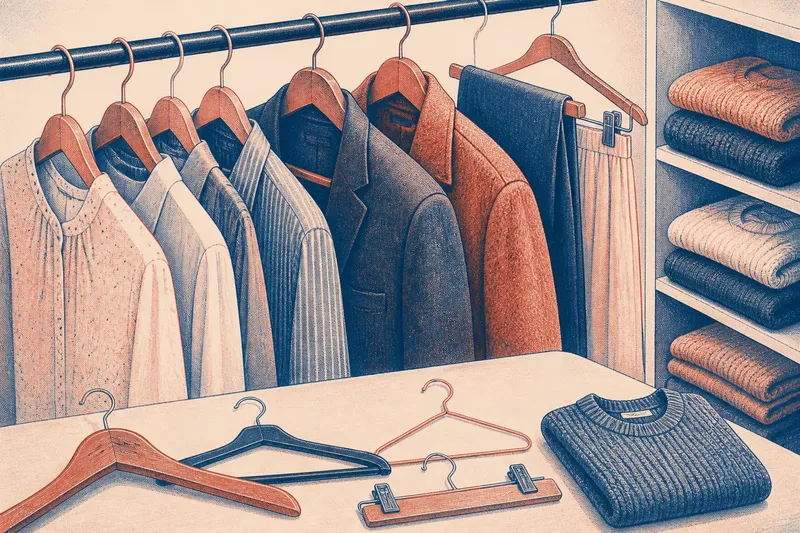
The right hanger for each garment should support the places that carry its weight, not simply match the rest of the wardrobe. A thin wire hanger may suit a light blouse, but can leave a ridge in a jacket or let a heavy coat pull its ends down.
There is no need to replace every hanger at once. Start with the garment’s construction: its shoulder line, fabric, weight and tendency to stretch. The useful question is not whether the hangers match, but whether the clothes are holding their shape.
What does the hanger need to support?
A hanger should sit near the garment’s shoulder seams without pushing them outwards. If it is too narrow, fabric can droop beyond the ends; if it is too wide, the shoulder tips may bulge or the seams may shift.
Consider where the garment is heaviest and how easily its fabric stretches. A broad support spreads weight across the shoulder area, while a narrow contact point can pull at light fabric or loosely knitted yarn. Smooth edges matter too: a rough join can catch delicate cloth even when the hanger is the right size.
Which hanger suits a jacket or coat?
Choose a broad, curved hanger for a structured jacket or substantial coat. Its shoulders should reach close to the garment’s seams and support the upper body, rather than leaving it suspended from a narrow bar.
Wooden and moulded hangers are common options, but their outline matters more than their material. Set one inside the jacket and check that it supports the shoulders without pressing at the tips. A soft, unstructured jacket may need less depth, but should not buckle over a thin wire.
For a heavy coat, check whether the hanger bends or tilts under the load. If it does, use a sturdier one. Leave enough space on the rail for the coat to hang freely; wedging it between other clothes can crease the fabric and squash its shape.
What works for shirts and blouses?
A smooth hanger close to the garment’s shoulder width is usually suitable for an everyday shirt. Slim plastic or wooden hangers can work if their edges are rounded and the shoulders do not extend past the support. If a shirt slides off, try a gently contoured hanger or one with a non-slip surface.
For a light blouse, inspect the hanger’s ends and seams for rough spots, then look for any marks where it supports the fabric. A wider, smooth shape can spread the load better than a narrow point. Buttoning the top button may help a collar sit neatly, but it cannot correct poor shoulder support.
Wire hangers are not inherently unsuitable. They can hold a light garment that fits them well; their narrow profile simply makes them a poor default for heavy pieces and defined shoulders.
When should knitwear be folded?
Fold heavy or loosely knitted jumpers rather than hanging them. Their weight can pull the shoulders and body down, especially when a thin hanger supports them over a small area. A shelf or drawer supports more of the garment at once.
A light knit that holds its shape may hang on a broad, smooth hanger. Check the shoulders and hem after hanging: if the fabric lengthens or develops bumps, fold it instead. When the knit is heavy, stretchy or prone to distortion, folding is the simpler choice.
How should trousers and skirts hang?
For trousers, use a smooth crossbar or clips that suit the fabric. A rounded bar lets the legs fold over without a sharp edge; clips can grip a waistband, but should not pinch delicate cloth. If they leave marks, move them to a sturdier seam or use a padded grip.
A lined, sturdy skirt may tolerate clips at its waistband. A fine fabric or a skirt with a heavy drape may stretch at the points where it hangs, so folding can be the better option. Check the fabric where the clips touch before leaving the garment stored that way.
How can you choose the right hanger for each garment?
Use these checks to make the choice from the garment’s visible condition. If the label or maker gives storage instructions, follow those first.
- Shoulder seams: Check whether the hanger ends sit close to the seams; if they fall short and fabric droops, choose a broader hanger, but if they press beyond the seams, choose a narrower one.
- Hanger shape: Check for sharp edges or rough joins; if they catch fabric, replace that hanger with a smooth one, but if the surface is smooth, continue checking fit and support.
- Weight: Check whether the hanger bends or tilts under the garment; if it does, move the garment to a sturdier hanger, but if it stays level, assess the shoulder support.
- Knitwear: Check for shoulder bumps or a lengthening body; if either appears, fold the garment, but if the knit remains in shape, a broad, smooth hanger may be suitable.
- Clips: Check the fabric where each clip grips; if marks appear, move the clips to a stronger seam or use padded clips, but if the fabric remains undisturbed, keep the current position.
- Rail space: Check whether the garment hangs freely; if it is wedged against its neighbours, make room or fold it, but if it hangs without pressure, leave it in place.
Say you have a wool jacket on a thin wire hanger and notice its shoulder fabric drooping beyond the ends. You check that the hanger is not bent, then place a broad, curved hanger inside the jacket; its ends sit near the shoulder seams without pressing them outwards. The visible result to look for is a more evenly supported shoulder line, not a magically restored jacket.
Which hanger questions come up most often?
Are wooden hangers better than plastic ones?
Neither material is automatically better. Choose by shape, smoothness and strength: a well-made plastic hanger may suit a shirt, while a broad wooden one may better support a structured coat.
Can clothes be stored on wire hangers?
Yes, if the garment is light, fits the hanger and does not slip. For heavy clothes, delicate knits or structured shoulders, choose broader support or fold the garment where appropriate.
Should every jumper be folded?
Heavy or stretchy jumpers are generally safer folded because hanging can pull at the shoulders. A light knit that keeps its form may hang on a broad, smooth hanger, provided it does not sag.
How can you tell if a hanger is the wrong size?
Look for shoulder fabric extending beyond the hanger, seams pushed upwards or a garment drooping sharply from its support. The hanger should sit close to the shoulder seams without forcing them outwards.
What is not worth the effort?
Replacing every hanger with one supposedly perfect type is not worth the effort. A wardrobe may look less uniform when each garment has suitable support, but matching the hangers is a cosmetic project; keeping shoulders and fabric free from avoidable strain is the useful one.
Choose the right hanger for each garment by looking at what bears its weight and what the fabric can tolerate. Broad support suits defined shoulders, while heavy knits generally belong folded. If a garment changes shape on its hanger, treat that visible change as a reason to adjust how it is stored.