A Scarf or a Belt: Two Ways to Change a Familiar Coat
A scarf or belt can change a familiar coat in different ways: use this comparison to choose where to add colour, shape, warmth or emphasis.
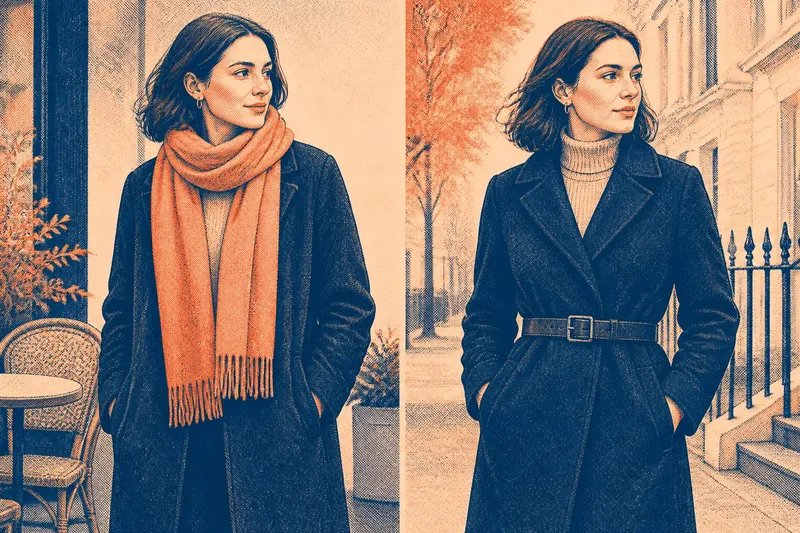
A scarf or belt changes a familiar coat by drawing the eye to a different place. For a soft shift in colour, texture or warmth, choose a scarf; for a more defined waist or a changed outline, choose a belt. The useful question is not which accessory is better, but what you want the coat to do.
1. What should the accessory change?
Start with the coat as it is, rather than with the scarf or belt you happen to own. Notice its length, fastening, collar, lapels and existing waist shape. A straight wool coat, a belted trench and a cropped jacket offer different places for an accessory to make a visible difference.
A scarf usually changes the area around the face, neck and chest. It can introduce a new colour, repeat one already in the outfit, or add a softer line over a firm coat. A belt acts further down the body and changes the coat’s outline by drawing fabric in or marking a waist.
Say you have a dark, straight-cut coat that feels severe over a plain jumper. If you want to soften the area around your face without changing the coat’s shape, a loosely draped scarf in a lighter tone may do the job. If you want the coat to look more fitted over the same jumper, a belt may be the more direct choice.
2. When does a scarf make more sense?
Choose a scarf when you want emphasis near the face, an extra layer at the neck or a contrast that does not alter the coat’s fit. It is particularly useful with coats that have a clean front, narrow lapels or no belt loops: the scarf can add interest without asking the coat to gather or hold extra fabric.
Its material affects the impression. A fine wool or cashmere scarf can sit neatly beneath a collar, while a thick knitted scarf makes a more substantial shape and may need to be worn over the lapels. A smooth silk scarf adds little warmth but can bring a sharper colour or pattern to a restrained coat.
Think about scale as well as colour. A broad, bulky scarf can crowd a small collar or obscure a high neckline; a narrow one may disappear against a large lapel. If the coat already has a busy check, prominent buttons or a strong collar, a plain scarf often gives the eye somewhere to rest.
The way you wear it changes the line. Draped ends create two vertical bands down the front, which can echo the opening of an unfastened coat. A looped or wrapped scarf gathers attention at the neck and can make the upper half feel more enclosed. Tucking the ends inside the coat keeps the front quieter and avoids a loose tail competing with the fastening.
It is not worth tying an elaborate knot solely to prove the scarf can be tied. If it slips, feels bulky beneath the collar or needs constant adjustment, a simpler drape is likely to serve the outfit better.
3. When does a belt make more sense?
Choose a belt when you want to give the coat a visible waist, alter its proportions or make its front feel more structured. It can turn a straight coat into a more shaped silhouette, although the result depends on how much fabric the coat has and where it can comfortably sit.
A belt supplied with the coat is usually the easiest place to begin. Its length, width and material were selected for that garment, and the belt loops show where it is meant to sit. If you replace it, look at the loops, existing belt width and texture of the fabric before choosing a different one. A narrow leather belt against a thick, soft coat can look detached; a heavy belt may overwhelm a light, sharply cut coat.
A belt can also change how much of the front remains visible. Fastening it firmly closes the coat and gathers fabric towards the waist. Tying it more loosely leaves more movement, but a knot or buckle still creates a focal point. If the coat has large pockets, a double-breasted front or prominent buttons, the belt adds another strong detail; consider whether that extra emphasis is wanted.
Belting is less useful when the coat is too small to close comfortably, the fabric pulls into uneven folds or the belt lands at an awkward point. In those cases, an open coat with a scarf may add definition through colour and vertical lines without forcing a new shape onto the garment.
4. Which effect do you want from the coat?
Use the intended effect to make the choice, rather than treating scarf and belt as interchangeable finishing touches.
- More colour near the face: choose a scarf, especially if the coat is a neutral shade.
- A clearer waist: choose a belt that sits naturally at the coat’s waist or belt loops.
- A softer line: choose a scarf with a drape that contrasts with the coat’s firmer structure.
- A more tailored impression: use the coat’s own belt or a compatible replacement, and keep other details restrained.
- More warmth without changing the fit: choose a scarf in a suitable insulating fabric and leave the coat’s outline alone.
- A quieter front: leave off a belt and wear a scarf tucked inside, or use neither if the coat already has enough detail.
These are tendencies, not rules. A bright belt can be a colour accent, while a dark scarf can make the neckline feel more defined. Look at the whole outfit: trousers, skirt, shoes and bag may already supply a strong focal point.
5. How do fabric and coat construction affect the choice?
Texture matters because the accessory sits against the coat, not against an abstract outfit. A smooth wool coat can take a textured scarf without becoming visually crowded. A nubby tweed coat may suit a fine, plain scarf better than another bulky surface. For a belt, a supple leather or fabric that relates to the coat’s finish tends to look more integrated than a material with an unrelated sheen.
Construction matters more than a belt’s apparent neatness. Belt loops suggest a position and help keep the belt in place; a coat without loops may still take a belt, but it can shift as you move. A thick, padded or highly structured coat may resist gathering, while a soft unlined coat can bunch unevenly. Check the coat’s label and maker’s care instructions before cleaning or storing an accessory with it.
Fastenings also affect the result. A scarf can obscure a high collar or a distinctive lapel, so adjust its position before deciding the coat looks crowded. A belt can cover buttons or pull a front closure out of alignment. If the coat is designed to hang open, forcing it into a tightly cinched shape may work against its cut.
6. What questions help you decide between them?
Can I wear a scarf and a belt together?
Yes, if each has a separate job: perhaps the scarf adds colour near the face while the belt gives the coat shape. Keep one relatively quiet so the two focal points do not compete across the front.
Should a scarf go inside or outside the coat?
Wear it inside when you want a tidy front or protection from the weather; wear it outside when its colour or texture is meant to be seen. The coat’s collar and the scarf’s bulk determine which arrangement sits comfortably.
Can I use a separate belt with a coat that has none?
You can, provided it sits securely and the coat fabric gathers without pulling or distorting. Try it over the coat rather than assuming a belt designed for trousers will hold its place on moving outerwear.
What if neither accessory improves the coat?
Leave the coat as it is. A strong collar, good buttons or an already defined waist may make an extra accessory unnecessary, and an outfit does not need to display every available option.
7. How can you compare the two without overthinking it?
Put the coat on over the clothes you intend to wear, then try the scarf and belt separately. Keep the lighting and the rest of the outfit unchanged so you are comparing the accessory rather than quietly rebuilding the whole look. Check the front, side and back: a belt that looks neat from the front may gather oddly at the back, while a scarf’s ends may interrupt the coat’s line.
Imagine you are wearing a charcoal single-breasted coat over a cream jumper and dark trousers. A rust-coloured wool scarf, draped over the lapels, would be expected to bring warmth and colour to the upper half while leaving the coat straight. The coat’s own belt, tied at the waist, would instead be expected to give the body a more shaped outline and make the fastening area the focus. Neither choice is inherently more polished; it depends on which change suits the rest of the outfit.
Make the final decision while moving, not just while standing still. Sit, walk and fasten the coat as you normally would. A scarf that slides off or a belt that restricts the front can be less useful than it looked in front of a mirror.
For a quick choice, remember the distinction: a scarf changes the coat’s emphasis, especially around the face, while a belt changes its outline. When deciding between a scarf or belt for a familiar coat, choose the one that solves the outfit’s actual imbalance, then leave the other in the wardrobe for a day when its particular job is needed.